

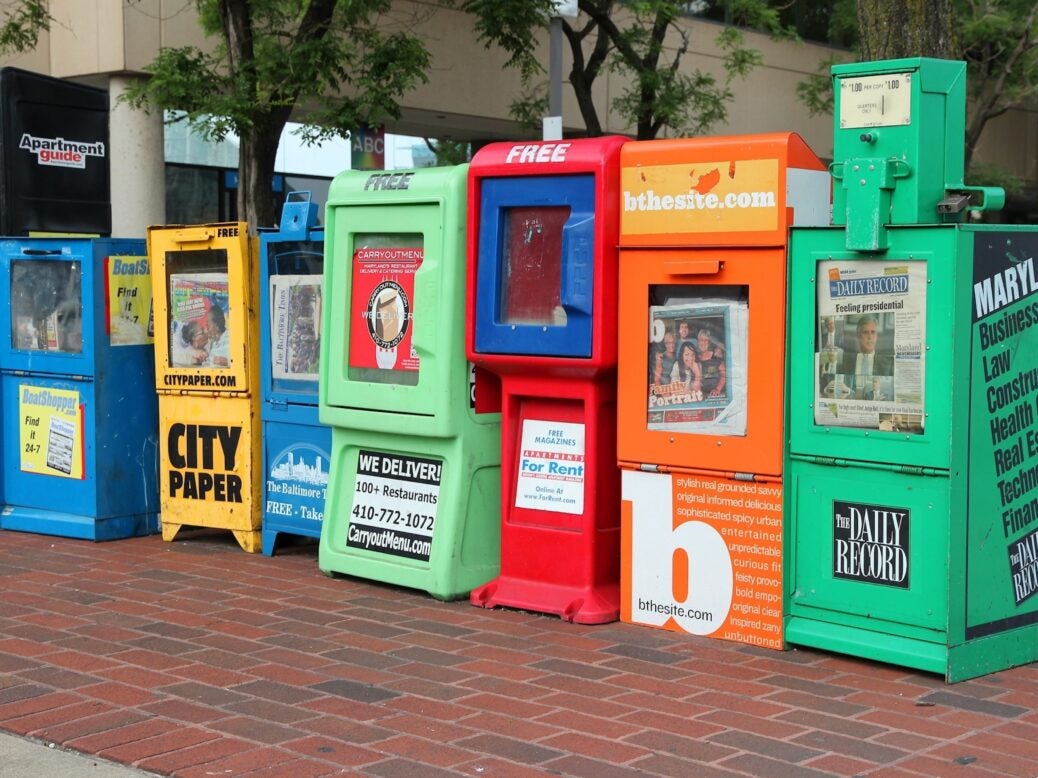
Just one of the 50 largest audited newspapers in the US grew its average daily print circulation year on year in the six months to March 2026.
Figures supplied exclusively to Press Gazette by the Alliance for Audited Media show that the top 50 titles by combined print and digital circulation saw a collective average year on year decline of 15%.
However, AAM has flagged that its circulation data does not include all digital newspaper subscriptions, and the non-profit organisation rolled out new digital reporting rules in February 2026.
[Read more: Alliance for Audited Media to modernise publisher digital circulation reporting]
It is also possible that there are newspapers that would have made the US top 50 list that do not currently report data to AAM. The group usually supplies circulation figures for 25 newspapers for the round-up, but this year supplied figures for 50.
The largest year-on-year decline was The Baltimore Sun, which saw its average daily print circulation down by 24.9% to 11,800 in the six months to 31 March 2026, from 15,721 during the same period a year earlier.
The Maryland-based title was bought by media mogul David Smith in 2024, with plans to attract new subscribers, serve a greater public interest and generate more profit. The purchase was followed by reports that the title had become more conservative in its editorial coverage, distancing some readers.
In June this year, the Washington politics and sports reporter for the paper, Jeff Barker, announced his resignation by noting it has “changed since its purchase by David Smith”.
The Minnesota Star Tribune saw the second biggest decline in average print circulation, down 24.2% to 54,800 (from 72,265 a year earlier).
This is despite the paper recording triple-digit growth month on month in online visits in January, likely linked to its coverage of Immigration and Customs Enforcement (ICE) activity in the state.
The Washington Post saw the third largest year-on-year decline, with a 23.9% drop to 77,900, down from 102,394. During the six-month period to March, the paper cut one-third of all staff as executive editor Matt Murray said “the company’s structure is too rooted in a different era, when we were a dominant, local print product”.
The Florida-based Villages Daily Sun was the only title to see a circulation increase year on year, up 1.7% to 54,900.
Collectively, the 50 papers in this analysis circulated 1.99 million issues per day on average in the six months to March. This is only around 250,000 more copies than the 25 newspapers included in the analysis for the six-month period to September, despite the March period covering twice as many titles.
The Tampa Bay Times has its average figures taken from Wednesdays and Sundays only.
Some 44 newspapers saw a half-on-half decline in circulation in the six-month period to March compared with the previous six-month period.
The combined average half-on-half decline across the top 50 titles was 5.77%. The biggest decline was at Hearst’s San Francisco Chronicle.
It was followed by The Baltimore Sun, down 15.7%, and the Minnesota Star Tribune, down 14.8%.
Six titles increased their print circulation on a half-on-half basis: Villages Daily Sun, up 12.8%, followed by USA Today Co’s Florida newspapers Sarasota Herald-Tribune (up 6% to 12,000) and The Palm Beach Post (up 3.4% to 12,400).
The South Florida Sun-Sentinel (up 2.9% to 13,400), Arizona Daily Star (up 1.8% to 13,900) and Indiana’s The Journal Gazette (up 1.6% to 14,800) also boosted their circulations compared to the previous six-month period.
USA Today Co owned the most titles among the top ten worst-performing titles on a half-on-half and year-on-year basis with five papers: Arizona Public (down 0.8% half on half and 20.2% year on year to 32,600), The Courier-Journal (down 10.6% and 21.5% to 11,900), the Democrat and Chronicle (down 10.1% and 17.8% to 11,400), Indianapolis Star (down 9.9% and 19.4% to 14,900), and The Record (down 9.8% and 16% to 11,400).
While print decline is ongoing across the industry, including in the UK, publishers are increasingly measuring performance by digital performance, including website traffic, engaged time and digital subscriptions.
Titles reporting print circulation in the hundreds of thousands attract millions of monthly site visits and digital subscribers.
Press Gazette’s monthly top 50 ranking of news websites in the US in July shows that the New York Times ranks top and records around 400 million visits.
It had the second-biggest average print circulation in the six months to March on 222,700. It was behind the Wall Street Journal, with an average print circulation of 391,200, despite the WSJ ranking 16th in the top 50 sites in July with around 67 million visits.
The effect of AAM’s new modernised reporting should be seen in the next top 50 round-up of US newspaper circulation, and is set to “give credit” to a wider range of audience channels, such as cross-device consumption, which could depict a more complete picture of performance for the US titles.
Email pged@pressgazette.co.uk to point out mistakes, provide story tips or send in a letter for publication on our "Letters Page" blog
